Indian martial arts refers to the fighting systems of the Indian subcontinent. A variety of terms are used for the English phrases "Indian martial arts", usually deriving from Dravidian sources. While they may seem to imply specific disciplines (e.1000. archery, armed combat), by Classical times they were used generically for all fighting systems.
Among the virtually common terms today, śastra-vidyā, is a compound of the words śastra (weapon) and vidyā (cognition).[1] Dhanurveda derives from the words for bow ( dhanushya ) and knowledge ( veda ), the "scientific discipline of archery" in Puranic literature, afterward applied to martial arts in general.[two] [ cocky-published source? ] The Vishnu Purana text describes dhanuveda every bit one of the traditional eighteen branches of "applied knowledge" or upaveda, forth with shastrashastra or military science.[iii] A later term, yuddha kalā, comes from the words yuddha meaning fight or gainsay and kalā significant fine art or skill. The related term śastra kalā (lit. weapon fine art) usually refers specifically to armed disciplines. Another term, yuddha-vidyā or "combat knowledge", refers to the skills used on the battlefield, encompassing not only bodily fighting but also boxing formations and strategy. Martial arts are usually learnt and practiced in the traditional akharas.[4] [v]
History [edit]
Antiquity (pre-Gupta) [edit]
An Indus valley civilization seal shows two men spearing one some other in a duel which seem to be centered on a woman. A statue of a spear thrower was likewise excavated from an Indus valley site.[half-dozen]
Dhanurveda, a department found in the Vedas (1500 BCE - 1100 BCE) contains references to martial arts.[7] [8] Indian epics contain the primeval accounts of gainsay, both armed and bare-handed. Virtually deities of the Hindu-Buddhist pantheon are armed with their own personal weapon, and are revered not only as primary martial artists simply oft every bit originators of those systems themselves.[nine] The Mahabharata tells of fighters armed merely with daggers besting lions, and describes a prolonged battle between Arjuna and Karna using bows, swords, trees, rocks and fists.[3] Some other unarmed battle in the Mahabharata describes two combatants boxing with clenched fists and fighting with kicks, finger strikes, knee strikes and headbutts.[10]
The oldest recorded organized unarmed fighting art in the Indian subcontinent is malla-yuddha or gainsay-wrestling, codified into four forms in the Vedic Period. Stories describing Krishna report that he sometimes engaged in wrestling matches where he used human knee strikes to the chest, punches to the head, pilus pulling, and strangleholds.[11] Based on such accounts, Svinth (2002) traces press-ups and squats used by Indian wrestlers to the pre-classical era.[11]
In Sanskrit literature the term dwandwayuddha referred to a duel, such that it was a battle between only two warriors and not armies. Epics often describe the duels between deities and god-like heroes equally lasting a month or more. The malla-yuddha (wrestling match) betwixt Bhima and Jarasandha lasts 27 days. Similarly, the dwandayuddha betwixt Parasurama and Bhishma lasts for xxx days, while that betwixt Krishna and Jambavan lasts for 28 days. Likewise, the dwandwayudda between Bali and Dundubhi, a demon in the form of a h2o buffalo, lasts for 45 days. The Manusmriti tells that if a warrior's topknot comes loose during such a fight or duel, the opponent must give him time to bind his hair before continuing.
The Charanavyuha authored by Shaunaka mentions iv upaveda (applied Vedas). Included among them are archery (dhanurveda) and military sciences (shastrashastra),[7] [8] the mastery of which was the duty (dharma) of the warrior class. Kings unremarkably belonged to the kshatria (warrior) class and thus served equally heads of the ground forces. They typically practiced archery, wrestling, boxing, and swordsmanship equally part of their education.[12] Examples include such rulers as Siddhartha Gautama and Rudradaman. The Chinese monk Xuanzang writes that the emperor Harsha was calorie-free on his anxiety despite his advancing age and managed to dodge and seize an assailant during an assassination endeavour.[13]
Many of the popular sports mentioned in the Vedas and the epics have their origins in armed forces training, such as battle (musti-yuddha), wrestling (maladwandwa), chariot-racing (rathachalan), horse-riding (aswa-rohana) and archery (dhanurvidya).[14] Competitions were held not just as a contest of the players' prowess simply also as a means of finding a bridegroom. Arjuna, Rama and Siddhartha Gautama all won their consorts in such tournaments.
In the 3rd century, elements from the Yoga Sutras of Patanjali, as well equally finger movements in the nata dances, were incorporated into the fighting arts.[11] A number of Indian fighting styles remain closely connected to yoga, dance and performing arts. Some of the choreographed sparring in kalaripayat tin be practical to dance[15] and kathakali dancers who knew kalaripayat were believed to be markedly better than other performers. Until recent decades, the chhau dance was performed merely by martial artists. Some traditional Indian classical trip the light fantastic schools however comprise martial arts every bit part of their do regimen.[16]
Written bear witness of martial arts in Southern India dates back to the Sangam literature of about the second century BC to the 2d century AD. The Akananuru and Purananuru describe the apply of spears, swords, shields, bows and silambam in the Sangam era. The word kalari appears in the Puram (verses 225, 237, 245, 356) and Akam (verses 34, 231, 293) to depict both a battlefield and gainsay arena. The discussion kalari tatt denoted a martial feat, while kalari kozhai meant a coward in war.[17] Each warrior in the Sangam era received regular armed forces training[eighteen] in target practice and horse riding. They specialized in one or more than of the important weapons of the menstruation including the spear (vel), sword (val), shield (kedaham), and bow and arrow (vil ambu). The combat techniques of the Sangam flow were the earliest precursors to kalaripayat.[iii] References to "Silappadikkaram" in Sangam literature appointment dorsum to the 2nd century. This referred to the silambam staff which was in great demand with foreign visitors.[19] [20]
The x fighting styles of northern sastra-vidya were said to have been created in different areas based on animals and gods, and designed for the item geography of their origin.[ commendation needed ] Tradition ascribes their convergence to the 6th-century Buddhist academy of Takshashila,[ citation needed ] ancient India's intellectual capital. Located in present-day Panjab, Islamic republic of pakistan, the Ramayana ascribes the city'south founding to Bharata who named it after his son Taksha. From the 7th to the 5th centuries BC information technology was held in high regard as a great centre of trade and learning,[21] attracting students from throughout present-day Islamic republic of pakistan and northern India. Amidst the subjects taught were the "military sciences", and archery was i of its prime number arts.
Some measures were put into place to discourage martial activity during the Buddhist period. The Khandhaka in particular forbids wrestling, boxing, archery, and swordsmanship. Nevertheless, references to fighting arts are establish in early Buddhist texts, such as the Lotus Sutra (c. 1st century AD) which refers to a boxing art while speaking to Manjusri.[22] It likewise categorised combat techniques as joint locks, fist strikes, grapples and throws. The Lotus Sutra makes further mention of a martial art with dance-similar movements chosen Nara. Another Buddhist sutra called Hongyo-kyo (佛本行集經) describes a "force contest" between Gautama Buddha's half-brother Prince Nanda and his cousin Devadatta.[22] Siddhartha Gautama himself was a champion wrestler and swordsman earlier condign the Buddha.[11]
Classical period (tertiary to 10th centuries) [edit]
Like other branches of Sanskrit literature, treatises on martial arts become more systematic in the course of the 1st millennium AD. Vajra-musti, an armed grappling fashion, is mentioned in sources of the early centuries Advertizement.[22] Around this time, tantric philosophers developed important metaphysical concepts such as kundalini, chakra, and mantra.[11]
The Sushruta Samhita (c. quaternary century) identifies 108 vital points on the human body[23] of which 64 were classified as being lethal if properly struck with a fist or stick.[eleven] Sushruta'due south work formed the ground of the medical bailiwick ayurveda which was taught alongside diverse martial arts.[11] With numerous other scattered references to vital points in Vedic and ballsy sources, it is certain that Indian subcontinent'south early fighters knew and practised attacking or defending vital points.[24]
Around 630, King Narasimhavarman of the Pallava dynasty commissioned dozens of granite sculptures showing unarmed fighters convincing armed opponents. This is similar to the manner described in the Agni Purana.[11]
Martial arts were not exclusive to the kshatriya caste, though the warrior class used them more than extensively. The 8th-century text Kuvalaymala past Udyotanasuri recorded fighting techniques being taught at educational institutions, where non-kshatriya students from throughout the subcontinent "were learning and practicing archery, fighting with sword and shield, with daggers, sticks, lances, and with fists, and in duels (niyuddham)".[iii] Hindu priests of the traditional gurukula still teach unarmed fighting techniques to their students as a fashion of increasing stamina and training the physical torso[ citation needed ].
The Gurjara-Pratihara came into power during the seventh century and founded a kyshatria dynasty in northern India which exceeded the preceding Gupta Empire. During this period, Emperor Nagabhata I (750–780 AD) and Mihir Bhoja I (836–890) commissioned various texts on martial arts, and were themselves practitioners of these systems. Shiva Dhanuveda was equanimous in this era. The khadga, a two-handed wide-tipped heavy longsword, was given special preference. It was even used for khadga-puja, ritualised worship of the sword. The Gurjara-Pratiharas continuously fought off Arab invasions, specially during the Caliphate campaigns in Bharat. The Arab chronicler Sulaiman wrote of the Gurjara ruler as the greatest foe to Islamic expansion, while at the same time praising his cavalry.[25] The Gurjara people however keep up their tradition of gatka and kushti, and until today there are world-class wrestlers from the community competing at national and international levels.
Middle Ages (11th to 15th centuries) [edit]
Kalaripayat had developed into its present form by the 11th century, during an extended catamenia of warfare between the Chera and Chola dynasties.[11] [15] The primeval treatise discussing the techniques of malla-yuddha is the Malla Purana (c. 13th century), dissimilar the earlier Manasollasa which gives the names of movements but no descriptions.[26]
Over a menses of several centuries, invading Muslim armies managed to occupy much of present-day Pakistan and northern India. In response to the spread of Muslim dominion,[27] the kingdoms of South India united in the 14th century to found the Vijayanagara Empire. Physical culture was given much attending by both royalty and commoners in the empire, with wrestling being particularly popular with both men and women.[28] Gymnasiums have been discovered inside purple quarters of Vijayanagara, and records speak of regular concrete preparation for commanders and their armies during peacetime.[29] Royal palaces and market places had special arenas where royalty and mutual people alike amused themselves past watching matches such as cockfights, ram fights, and wrestling. One account describes an akhara in Chandragiri where noblemen practiced jumping exercises, boxing, fencing and wrestling near every day before dinner to maintain their health, and observed that "men as quondam every bit seventy years wait only xxx".[30]
The Italian traveller Pietro Della Valle wrote of cane-fighting in southern Bharat. According to Pietro, it was the custom for soldiers to specialise in their own item weapon of expertise and never use any other fifty-fifty during war, "thereby becoming very good and well practised in that which he takes to".[31]
Equally their ancient predecessors, swordplay and wrestling were unremarkably practiced by the royalty of Vijayanagara. Krishna Deva Raya is said to have arranged a duel betwixt a champion swordsman and the prince of Odisha who was known for being an skilful with both the sword and dagger. The prince accepted the claiming until he learned he would be fighting one not of purple claret and so killed himself rather than having to "soil his easily". Fernao Nunes and the Persian envoy Adbur Razzak relate that Deva Raya II survived an assassination effort "as he was a human who knew how to employ both sword and dagger improve than anyone in his kingdom, avoided past twists and turns of his body the thrusts aimed at him, freed himself from him, and slew him with a short sword that he had."[32]
Mughal era (1526–1857) [edit]
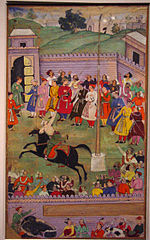
Mughal warriors practicing horseback archery, a skill they were highly renowned for
Afterwards a series of victories, the Central Asian conqueror Babur established Mughal dominion in north Bharat during the 16th century. The Mughals were patrons of India's native arts, not only recruiting akhara-trained Rajput fighters for their armies merely fifty-fifty practicing these systems themselves.[33] The Ausanasa Dhanurveda Sankalanam dates to the late 16th century, compiled under the patronage of Akbar.[34] The Ain-i-Akbari tells that the Mughal court had diverse kinds of fighting men from around the empire who would demonstrate their skills every solar day in exchange for rewards. Among them were said to be both native and Mughal wrestlers, slingers from Gujarat, Hindustani athletes, boxers, stone-throwers and many others.
"There are several kinds of gladiators, each performing astonishing feats. In fighting they show much speed and agility and blend backbone and skill in squatting downwardly and rising up over again. Some of them use shields in fighting, others utilize cudgels. Others again use no ways of defence, and fight with 1 hand only; these are called ek-hath. Those who come from the eastern districts of Hindostan apply a pocket-sized shield called "chirwah". Those from the southern provinces have shields of such magnitude as to encompass a man and a horse. This kind of shield is called tilwah. Another class use a shield somewhat less than the height of a man. Some again utilize a long sword, and seizing it with both hands they perform extraordinary feats of skill. There is some other famous class called Bankúlis. They have no shield just make employ of a peculiar kind of sword which, though curved towards the point, is straight near the handle. They wield information technology with smashing dexterity. The skill that they exhibit passes all description. Others are skillful in fighting with daggers and knives of various forms; of these there are upward of a hundred g. Each grade has a dissimilar name; they also differ in their performances. At court, at that place are a thousand gladiators ever in readiness."[35]
Avid hunters, a pop sport among the Mughals was shikar or tiger-hunting. While oftentimes done with arrows and afterward even rifles, it was considered most impressive to kill a tiger with a hand-to-hand weapon such as a sword or dagger.[36] A warrior who managed to best a tiger would be awarded the title of Pachmar.
In the 16th century, Madhusudana Saraswati of Bengal organised a department of the Naga tradition of armed sannyasi in order to protect Hindus from the intolerant Mughal rulers. Although generally said to abide by the principle of non-violence (ahimsā), these Dashanami monks had long been forming akhara for the exercise of both yoga and martial arts. Such warrior-ascetics take been recorded from 1500 to as belatedly as the 18th century,[37] although tradition attributes their creation to the 8th-century philosopher Sankaracharya. They began as a stratum of Rajput warriors who would gather after harvest and arm peasants into militarised units, effectively acting as a self-defence squad. Prevalent in Rajasthan, Maharashtra and Bengal, they would requite upwards their occupations and leave their families to live as mercenaries. Naga sadhu today rarely practise any grade of fighting other than wrestling, but however carry trishula, swords, canes and spears. To this day their retreats are called chhauni or armed camps, and they have been known to hold mock jousts amidst themselves. Every bit recently every bit the 1950s, it was not unusual for Naga sadhu to strike to kill someone over issues of honour.[web ane]
There is too a 17th-century Dhanurveda-samhita attributed to Vasistha.
The pehlwani mode of wrestling adult in the Mughal Empire by combining native malla-yuddha with influences from Persian varzesh-e bastani.[38] [39]
Maratha dynasty (1674–1859) [edit]

Statue of Shivaji, the warrior-king who brought the Maratha people and fighting style to prominence.
Coming from a hilly region characterized by valleys and caves, the Marathas became good horsemen who favoured light armour and highly mobile cavalry units during war. Known especially as masters of swords and spears, their heavily martial civilisation and propensity for the lance is mentioned equally early as the seventh century by Xuanzang.[13] Later serving the Dakshin sultanates of the early 17th century, the scattered Marathas united to found their ain kingdom under the warrior Shivaji. Having learned the native fine art of mardani khela from a young historic period, Shivaji was a master swordsman and proficient in the use of various weapons.[40] He took reward of his people's expertise in guerilla tactics (Shiva sutra) to re-establish Hindavi Swarajya (native [Hindu beingness a term traditionally practical to the native inhabitants of Bharat throughout antiquity] self-rule) at a time of Muslim supremacy and increasing intolerance.[21] Utilizing speed, focused surprise attacks (typically at night and in rocky terrain), and the geography of Maharashtra, Karnataka, & Southward India; the Maratha rulers were successfully able to defend their territory from the more numerous and heavily armed Mughals.[41] The even so-existing Maratha Calorie-free Infantry is ane of the "oldest and near renowned" regiments of the Indian Regular army, tracing its origins to 1768.[42]
Paika Rebellion [edit]
Paika is the Odia word for fighter or warrior. Their training schools, known as paika akhada, can exist traced back to ancient Kalinga and their art was at one time patronised by King Kharavela.[43] In March 1817, under the leadership of Bakshi Jagabandhu Bidyadhar Mohapatra, nigh 400 Khanda of Ghumusar in Ganjam marched towards Khordha in protestation against British colonial rule. Many authorities buildings were burnt down and all the officials fled. The British commander of one detachment was killed during a battle at Gangapada. The paika managed to capture two bases at Puri and Pipli before spreading the rebellion further to Gop, Tiran, Kanika and Kujang. The revolt lasted a year and a half before existence quelled by September 1818.[44] [45] [46] Today the paika akhada are known mainly for their street performances during festivals.
Modernistic period (1857—present) [edit]
Indian martial arts underwent a period of decline after the total establishment of British colonial rule in the 19th century.[24] More than European modes of organizing kings, armies and governmental institutions, and the increasing use of firearms, gradually eroded the demand for traditional gainsay training associated with degree-specific duties.[15] The British colonial authorities banned kalaripayat in 1804 in response to a series of revolts.[47] Silambam was also banned and became more mutual in the Malay Peninsula than its native Tamil Nadu. Nevertheless, traditional fighting systems persisted, sometimes fifty-fifty nether the patronage of enthusiastic British spectators who tended to remark on the violence of native boxing and the acrobatic movements characteristic of Indian fighting styles.[ commendation needed ]
The British took reward of communities with a heavily militaristic culture, characterising them as "martial races" and employing them in the armed forces. Sikhs – already known amongst Indians for their martial practices – were particularly valued by the colonists equally soldiers and guards, and were posted throughout not only India but Southeast Asia and other parts of the British Empire[ citation needed ]. Members of the army were allowed to box as a way of settling disputes, provided that they were still able to comport out their duties as soldiers after a friction match.[48] The particular course of boxing used by the Punjabi soldiers was loh-musti,[ commendation needed ] as the kara worn past Sikhs could be wielded similar brass knuckles.
The resurgence of public interest in kalaripayat began in the 1920s in Tellicherry as part of a wave of rediscovery of the traditional arts throughout s India which characterised the growing reaction against British colonial dominion.[15] During the following iii decades, other regional styles were subsequently revived such as silambam in Tamil Nadu, thang-ta in Manipur[49] and paika akhada in Orissa.[50]
Texts [edit]
Agni Purana [edit]
One of the primeval extant manual of Indian martial arts is in the Agni Purana (dated to between the 8th and the 11th century),[24] The dhanurveda department in the Agni Purana spans chapters 248–251, categorizing weapons into thrown and unthrown classes and further divided into several sub-classes. Information technology catalogs training into v major divisions for different types of warriors, namely charioteers, elephant-riders, horsemen, infantry, and wrestlers.
The nine asanas (stances) in the fight are listed below:
- samapada ("holding the feet even"): standing in closed ranks with the anxiety put together (248.9)
- vaiśākha : standing cock with the anxiety autonomously (248.ten)
- maṇḍala ("deejay"): standing with the knees apart, arranged in the shape of a flock of geese (248.xi)
- ālīḍha ("licked, polished"): bending the correct knee with the left human foot pulled back (248.12)
- pratyālīḍha : bending the left knee with the right foot pulled dorsum (248.13)
- jāta ("origin"): placing the right human foot directly with the left pes perpendicular, the ankles being five fingers autonomously (248.14)
- daṇḍāyata ("extended staff"): keeping the right knee bent with the left leg directly, or vice versa; called vikaṭa ("dreadful") if the 2 legs are ii palm-lengths apart (248.xvi)
- sampuṭa ("hemisphere") (248.17)
- swastika ("well-existence"): keeping the feet 16 fingers autonomously and lifting the feet a little (248.xix)
Then there follows a more detailed discussion of archery technique.
The section concludes with listing the names of actions or "deeds" possible with a number of weapons, including 32 positions to be taken with sword and shield ( khaḍgacarmavidhau ),[51] eleven names of techniques of using a rope in fighting, along with 5 names of "acts in the rope performance" along with lists of "deeds" pertaining to the chakram (war-quoit), the spear, the tomara (iron gild), the gada (mace), the axe, the hammer, the bhindipāla or laguda, the vajra, the dagger, the slingshot, and finally deeds with a bludgeon or cudgel. A short passage near the end of the text returns to the larger concerns of warfare and explains the various uses of war elephants and men. The text concludes with a description of how to appropriately send the well-trained fighter off to war.[52]
Arthashastra [edit]
The Arthashastra, c. 4th century BCE, typically attributed to Chanakya principal advisor of Chandragupta Maurya is one of the earliest treatises on statecraft, including diverse topics such as economic science, politics, affairs and military strategy.
Others [edit]
There is an extant Dhanurveda-Samhita dating to the mid-14th century, by Brhat Sarngadhara Paddhati (ed. 1888).[53]
Other scattered references to fighting arts in medieval texts include the:
Kamandakiya Nitisara (c. 8th century[54] ed. Manmatha Nath Dutt, 1896),
The Nitivakyamrta by Somadeva Suri (10th century),
The Yuktikalpataru of Bhoja (11th century) and
The Manasollasa of Somesvara Three (12th century)
Weapons & Arts [edit]
A wide array of weapons are used in the Indian subcontinent, some of which are not found anywhere else. Co-ordinate to P.C. Chakravati in The Fine art of War in Ancient India, armies used standard weapons such as wooden or metal-tipped spears, swords, thatched bamboo, wooden or metal shields, axes, brusque and longbows in warfare equally early on as the 4th century BC.[55] Military accounts of the Gupta Empire (c. 240–480) and the subsequently Agni Purana identify over 130 different weapons.
The Agni Purana divides weapons into thrown and unthrown classes. The thrown (mukta) class includes twelve weapons altogether which come up under four categories, viz.

The katara, the most characteristic[36] of daggers in the Indian subcontinent.
- yantra-mukta: projectile weapons such every bit the sling or the bow
- pāṇi-mukta: weapons thrown by mitt such as the javelin
- mukta-sandarita: weapons that are thrown and drawn back, such as the rope-spear
- mantra-mukta: mythical weapons that are thrown by magic incantations (mantra), numbering half dozen types
These were opposed to the much larger unthrown form of three categories.
- hasta-śastra or amukta: melee weapons that practise not leave the mitt, numbering twenty types
- muktāmukta: weapons that can be thrown or used in-close, numbering 98 varieties
- bāhu-yuddha or bhuja-yuddha: weapons of the body, i.e. unarmed fighting
The duel with bow and arrows is considered the noblest, fighting with the spear ranks next, while fighting with the sword is considered unrefined, and wrestling is classed as the meanest or worst grade of fighting. Only a Brahmins could be an acharya (teacher) of sastravidya, Kshatriya and vaishya should learn from the Acharya, while a shudra could non take a teacher, left to "fight of his own in danger".[56]
Over time, weaponry evolved and Bharat became famous for its flexible wootz steel. The near usually taught weapons in the Indian martial arts today are types of swords, daggers, spears, staves, cudgels, and maces.[57]
Weapons are linked to several superstitions and cultural beliefs in the Indian subcontinent. Drawing a weapon without reason is forbidden and considered by Hindus to be disrespectful to the goddess Chandika. Thus the saying that a sword cannot be sheathed until it has drawn blood. It was a mother's duty to tie a warrior's sword around his waist before war or a duel. In addition, she would cutting her finger with the sword and make a tilak on his head from a drib of her blood. Weapons themselves were too anointed with tilak, about often from the claret of a freshly-decapitated goat (chatanga). Other taboos include looking at ane's reflection in the blade, telling the price or source of conquering, throwing it on the ground or using it for domestic purposes.[web 2]

A southern two-handed sword
Swordsmanship (Khadgavidya) [edit]
Nakula and Sahadeva are said to be skilled swordsmen in Mahabharata. Sword-fighting[58] is i of the common Indian fighting arts. Varieties include the curved single-border sword, the straight double-border sword, the two-handed longsword, the gauntlet-sword, and the urumi or flexible sword. Techniques differ from i state to another merely all make extensive utilize of circular movements, often circling the weapon effectually the user's head. The flexible nature and lightweight of Indian swords allows for speed simply provides piffling defensive power, so that the swordsman must instead rely on body maneuvers to contrivance attacks. Entire systems exist focusing on drawing the sword out of the opponent's trunk. Stances and forms traditionally fabricated upwards the early grooming before students progress to gratuitous sparring with sticks to simulate swords in an practice called gatka, although this term is more often used in English language when referring to the Panjabi-Sikh fighting way. A common manner to exercise precision-cut is to slice cloves or lemons, eventually doing so while blindfolded. Pairing two swords of equal length, though considered impractical in some parts of the world, is common and was considered highly advantageous in the Indian subcontinent.[57]
Staffplay (Lathi khela) [edit]
Stick-fighting (lathi khela) may be taught as part of a wider system like Gatka, silambam or on its own.[ citation needed ] In the Kama Sutra the sage Vātsyāyana enjoins all women to exercise fighting with single-stick, quarterstaff, sword and bow and arrow in improver to the art of dearest-making. The stick (lathi in Prakrit) is typically made of bamboo with steel caps at the ends to forbid information technology from splintering.[ citation needed ] Wooden sticks made from Indian ebony may as well be used.[ citation needed ] It ranges from the length of a cudgel to a staff equal to the wielder'south height.[ citation needed ] The stick used during matches is covered in leather to cushion the affect.[ citation needed ] Points are awarded based on which part of the body is hit. Techniques differ from system to system, just northern styles tend to primarily use merely i end of the staff for attacking while the other stop is held with both hands.[ commendation needed ]
Southern styles like likewise brand utilize of this technique just volition more than ofttimes utilize both ends of the staff to strike. The latter is the more common method of attacking in the eastern states and Bangladesh, combined with squatting and frequent changes in elevation.[ citation needed ]
Spearplay [edit]
Yudhishthira is said to be a chief in spearplay warfare in Mahabharata, while Shalya was besides noted to be an splendid warrior in the field of spearplay. Also co-ordinate to Indian Hindu myths, Kartikeya, the son of Lord Shiva, is said to be skilled in spear-fighting, by holding his divine spear called Vel. The Indian spear is typically made of bamboo with a steel blade. Information technology can be used in hand-to-manus combat or thrown when the fighters are farther apart. Despite primarily being a thrusting weapon, the wide spearhead besides allows for many slashing techniques. By the 17th century, Rajput mercenaries in the Mughal regular army were using a type of spear which integrated a pointed spear butt and a club near the head, making it like to a mace. On the other paw, the longer cavalry spear was made of wood, with red cloth attached nearly the blade to prevent the opponent'south blood from dripping to the shaft. The Marathas were revered for their skill of wielding a ten-foot spear called bothati ( ਬੋਥਾਟੀ ) from horseback. Bothati fighting is skilful with a ball-tipped lance, the cease of which is covered in dye so that hits may hands exist confirmed. In solo preparation, the spear is aimed at a pile of stones. From this was eventually developed the uniquely Indian vita which has a 5 feet (1.5 g) length of cord attached to the butt finish of the weapon and tied around the spearman's wrist. Using this string the spear tin can be pulled back later it has been thrown.[57] [59]
Archery (Dhanurvidya) [edit]
Archery[60] is noted to be i of the noblest form of defense within Indian cultural heritage. Equally mentioned in Vedic literature, the bow and arrow is the most applauded weapon among Kshatriyas. Siddharta Gautama was a champion with the bow, while Rama, Arjuna, Karna, Bhishma, Drona and Ekalavya of the epics were all said to be peerless archers.
Dhanurveda is an ancient treatise on the science of archery. It describes the practices and uses of archery, the craft of bow and pointer making, preparation of the army, and enumerates the rules of date. The treatise too discusses martial arts in relation to the training of warriors, charioteers, cavalry, elephant warriors, infantry etc. It was considered as a sin to shoot a warrior from the dorsum and fight more than than one warrior at a time. The bow used in the Vedic menses were chosen danush, and were described in detail in the Vedas. The curved shape of the bow is called vakra in the Artha Veda. The bowstring was chosen jya, and was strung only when needed. An arrow was called an iṣu, and a quiver was called an iṣudhi which was slung on the back.[61] Archers wore a hastaghna, which was an arm guard or shield normally worn on the left forearm and was used to protect the wearer from friction acquired by the bowstring.
A dhanushkara was a bowyer, or the profession of bow crafting and arrow making, and it had go a regular profession past the early on Vedic menstruation. Others called jyakara specialized in making bowstrings.
Composite bows made of horn, sinew, and wood were invented in the Asian Steppes and would take been an integral part of the armory of the Aryan people. As in other civilizations such every bit the Hittites and Persians, the employ of blended bows coincides with chariot warfare. Additionally the smaller size was of the compound bow would have made it preferable on mounted warfare.
A type of Indian longbow was v to half dozen feet long and fired a long pikestaff pointer with metallic or os pointer heads. The Cretan chronicler Nearchus who accompanied Alexander the Corking into India, had noted that the warriors would utilise a bamboo bow, which had to rest on the ground and steady with the feet to draw to its full length. The pointer fired from this bamboo bow could penetrate any armor used in artifact.[62] The Indian long bows were described as the height of their users by Arrian, and Deccan bows in 1518 as "long like those of England".[63]
Traditional archery is today practiced mainly in the far northern states of Ladakh and Arunachal. One sport which has persisted into the nowadays 24-hour interval is thoda from Himachal Pradesh, in which a team of archers try to shoot blunt arrows at the legs of the opposing team.[14]
Mace-fighting (Gadayuddha) [edit]

Gada (mace) is the weapon of God Hanuman in Ramayana. Lord Vishnu besides carries a gada named Kaumodaki in ane of his iv hands. In the Mahabharata epic, the fighters Bhima, Duryodhana, Jarasandha and Balarama were said to be masters of the gada. In the mace gainsay, Bhima wins the concluding battle against Duryodhana by hitting his inner thigh. Such an assault below the waist was said to exist against the etiquette of mace duels, implying a degree of commonality to this type of fighting. It was and still is used as training equipment by wrestlers. The traditional gada (mace) was essentially a wooden or steel sphere mounted on a handle and with a unmarried spike at the elevation. An alternative mace-head was the lotus-shaped padam. Co-ordinate to the Agni Purana, the gada tin be handled in xx different ways. Due to its weight, the gada is said to be best suited to fighters with a large build or swell strength. The Mughal club or mace, known as a gurj or gargaj, had a head consisting of 8–ten petal-shaped blades. Fitted with basket-hilt, a spherical pommel, and a spiked summit, this type of club was designed for beating down armour-clad opponents. Alternatively, some gurj had a spiked top and a hand-baby-sit.[web 3]
Wrestling (Mallayuddha) [edit]
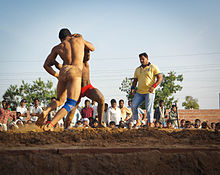
Wrestling match in Bharatpur, 2013.
Grappling arts (malla-vidya), practiced either as sport or fighting fashion, are institute throughout the Indian subcontinent. True combat-wrestling is called malla-yuddha, while the term malakhra refers to wrestling for sport. Malla-yuddha was codified into four forms which progressed from purely sportive contests of strength to actual full-contact fights known equally yuddha.[57] Due to the extreme violence, this terminal grade is generally no longer practised. The second form, wherein the wrestlers attempt to lift each other off the ground for 3 seconds, persists in Karnataka. Traditional malla-yuddha is virtually extinct in the north where information technology has been supplanted by kusti, but some other form called malakhra notwithstanding exists in parts of India and Sindh, Islamic republic of pakistan[ citation needed ]. Vajra-musti was another old grappling art in which the competitors wrestled while wearing a horned knuckleduster. In a later style chosen naki ka kusti (claw wrestling), the duellists fought with bagh nakha.[64] Numerous styles of folk wrestling are also institute in Republic of india's countryside, such as mukna from Manipur, Inbuan wrestling from Mizoram and Khomlainai amongst the Bodos.
Wrestling (Pehlwani) [edit]
Pehlwani is a form of wrestling from the Indian subcontinent. It was developed in the Mughal Empire by combining native malla-yuddha with influences from Persian varzesh-e bastani.[38] [39] One of the most famous practitioners of pehlwani was The Great Gama (Ghulam Mohammad Baksh Butt), who is considered i of the greatest wrestlers of all time.[65]
Boxing (Mushtiyuddha) [edit]
Boxing (musti-yuddha) is traditionally considered the roughest form of Indian unarmed combat. In ancient times it was popular throughout northern Indian subcontinent, but is rarely expert today. Boxers harden their fists by striking stone and other hard objects. Matches may be either one-on-ane or group fights. All kinds of strikes and grabs are allowed, and whatsoever part of the body may be targeted except the groin.[57] Another class of boxing was loh-musti (meaning "iron fist"), said[ by whom? ] to have been practiced by the God Krishna[ citation needed ]. In this variation, boxers fought while wielding a kara or steel bracelet like a knuckleduster[ citation needed ]. Grabs, kicks, biting and attacks to the groin were all legal, the only prohibition being spitting on the opponent which was considered crude and dishonourable[ citation needed ]. The kara used for regular matches was unadorned[ commendation needed ], but the form employed during state of war had ane or more spikes effectually its edge[ citation needed ]. The kara may be paired with one on each manus[ citation needed ], but it was generally merely worn on i hand then the other mitt could be left free[ citation needed ]. In some cases the gratis mitt could be paired with another weapon, nigh commonly the bagh nakha[ citation needed ].
Kicking [edit]
Kicking-fighting (aki kiti) is the preserve of tribes from Nagaland. While the entire Naga population of northeast Bharat and northwest Myanmar was traditionally known for their skill with broadswords (dao) and other weapons, disputes amidst tribesmen and between tribes were settled with a solely kick-based course of unarmed fighting. The goal is to either drive the opponent to their knees or outside of the ring. But the feet are used to strike, and even blocking must exist done with the legs.[66]
Pugilism [edit]
Many forms of unarmed gainsay (bāhu-yuddha or bhuja-yuddha) comprise too wide an assortment of techniques to exist accurately categorized. In modernistic times when the conveying of weapons is no longer legal, teachers of the martial arts often emphasise the unarmed techniques as these are seen to be more practical for cocky-defence purposes. A warrior who fights unarmed is referred to as a bhajanh, literally meaning someone who fights with their arms. The blank-handed components of Indian fighting arts are typically based on the movements of animals, Hindu deities. Binot, a Central Indian art which focuses on defending confronting both armed and unarmed opponents, maybe the earliest system of its kind. In the Mughal era, such fighters were known as ek-hath (lit. "one-mitt"), so named because they would demonstrate their fine art using just ane arm.[57]
Bal Vidya [edit]
64 unlike types of skills and arts existed in ancient India which lead to well-developed individuals boosting their mind, body, and intellect making them capable of performing their responsibilities efficiently and effectively on personal, social and national level. Today, unhealthy and irregular lifestyles, frustrations and rising competitions in every sphere of life are affecting the health of people, especially the youth. In such a scenario, one of the ancient Indian arts referred to as "Bal Vidya" can help non only to improve the physical wellness but also upscale the mental and intellectual well-being of a person. A potent listen and intellect is equally important along with a strong body. Shree Aniruddha Upasana Foundation (Mumbai, India) attempts to review these aboriginal Indian martial arts form and provides "Bal Vidya" preparation to both men and women free of charge. Art forms like Mudgal Vidya, Vajra Mushthi, Surya Bhedan, Ashwa and various types of Yashwanti Malla Vidya using various weapons similar Laathi (iron-bound bamboo stick), Kaathi (Pole), Fari-Gadga, Dorkhand (rope)and Dandpatta (gauntlet-sword). A book detailing all these art forms with the title "Bhartiya Prachin Bal Vidya" (The Ancient Indian Bal Fine art) is too bachelor for achieving proficiency through practice mail service attending preparation sessions.[67] [68] [69] [ circular reference ] [lxx]
Systems [edit]
As in other respects of Indian culture, Indian martial arts tin can be roughly divided into northern and southern styles. The northern systems (including Islamic republic of pakistan and Bangladesh) may generically be referred to as shastra-vidiya, although this term is often used synonymously with gatka. The main divergence is that the northward was more exposed to Persianate influence during the Mughal period, while the south is more conservative in preserving aboriginal and medieval traditions. The exception to this rule are the northeastern states which, due to their geographic location, were closed off from most pre-European strange invaders. Every bit a effect, northeast Indian culture and fighting methods are also closely related to that of Southeast Asia. In addition to the major division between due north and southward, martial systems in the Indian subcontinent tend to exist associated with certain states, cities, villages or ethnic groups.[71]
Regional styles [edit]
- Andhra Pradesh
Masters in Andhra Pradesh trace their lineage to the Vijayanagara empire, popular in Konaseema region. The native system of Chedi Talimkhana or yudhkaushalya che talim is often abbreviated to Talimkhana or only Talim. The art makes utilise of several weapons which are used in preset forms. These include knife fighting (baku samu), sword fighting (katti samu), and staff fighting (kara samu) in addition to other weapons such as the gada (mace) and pata (guantlet sword).[spider web 4] [71]
- Bengal and Northeast Bharat
Bengali war-dances bear testament to the weapons once used in the Bengal region. Today virtually of these weapons are used just in choreographed fights, including dao khela (pocketknife fighting) and fala khela (sword fighting)[ commendation needed ]. Traditional stick-fighting (lathi khela) is still used in free sparring today[ citation needed ]. The sticks may be brusque like a cudgel or a long staff. The onetime are sometimes paired with a shield.[ citation needed ]
Lathi khela is a traditional Bengali martial art[72] [73] – a kind of stick fighting practised mainly in Bengal[72] [73] and Northeast Bharat. Stick fighting has an ancient history in the Indian subcontinent. Rich farmers and other eminent people hired lathial for security and equally a symbol of their power. Duels were used every bit a fashion to protect or take land and other possessions. A proverb in some South Asian languages is "whoever wields the lathi keeps the cow". Zamindars (feudal lords) sent groups of lathial to forcefully collect taxes from villagers. Lathi training was at in one case included in the Bratachari system of education.[72] [73]
- Bihar
"Pari-khanda" is a fighting form created past Rajputs and is withal practised in many parts of Bihar. "Pari" means shield and "khanda" means sword according "Chhau" region, therefore this art uses sword and shield for fighting. This fighting class has given nascence to a local trip the light fantastic form named "Chhau" trip the light fantastic toe and its martial elements have been fully absorbed by this trip the light fantastic toe. Information technology is even practised in some parts of Jharkhand and Odisha. Chhau is the proper noun of the traditional trip the light fantastic- drama of the eastern regions of Bharat and is of three types. The three forms of "Chhau" are named after the district or village where they are performed, i.e. the Purulia Chau of Bengal, the Seraikella Chau of Bihar and the Mayurbhanj Chau of Orissa.
- Karnataka
The Kannada fighting arts are taught exclusively at traditional training halls or garadi mane. Disciplines include unarmed combat (kai varase), staff-fighting (kolu varase) and sword-fighting (katti varase) among various other weapons. These are most ofttimes seen today simply during choreographed demonstrations at festivals.[71]
- Kashmir
Kashmiri swordsmanship is said to have an aboriginal history, but it was but much later that information technology acquired its modern name of sqay. Sqay survived a reject post-obit the partition of India by adopting competitive methodologies of karate and taekwondo. Types of contest include sparring, breaking, and forms or khawankay. Practitioners spar using simulated swords called tora which are paired with a shield. Sparring is indicate-based, the points existence awarded for successful hits with the tora or with the foot.[74]
- Kerala
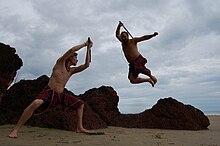
Kalaripayat stick-fighting
The Keralite martial of Kalaripayattu, came into its nowadays class through the kalari, the local variation of the gurukula educational establishment in Kerala. The almost common weapons today are the staff, stick, sword, shield, spear, dagger and flexible sword, locally known every bit Urumi.[15] Kerala is as well home to a native form of submission wrestling chosen Gatta gusthi.
- Maharashtra
The Marathas developed their fighting mode based on the state's hilly geography. Mardani khel today teaches armed techniques for apply in unmarried gainsay likewise equally defence force confronting several opponents. Other weapons include the sword, shield, spear, dagger, kukri, double deer horns, and bow and arrow.[71]
- Manipur
The Manipuri art of Huyen langlon was once practiced by the country'south indigenous hill tribes who would appoint in duels governed past strict rules of conduct. The armed component called thang-ta is named after the organization'south main weapons, the thang (sword) and ta (spear). Practitioners spar through cheibi gatka in which a cream sword is used together with a shield. Unarmed huyen lalong is chosen sarit-sarak and is used in conjunction with thang-ta when the fighter loses their weapon.[9]
- Nagaland
Aki Kiti is a semi-contact combat sport characterized by kicking and blocking solely using the soles of the feet. The word Aki Kiti means "kick fighting".
- Odisha
The Odishan martial art traces back to the paika course of warriors who were specially known for their employ of the khanda or double-border direct sword. During times of peace, the paika would hone their skills through martial dances, forms-preparation and various acrobatics.[75] Their descendants take preserved these exercises in training halls called paika akhada, and demonstrate them mainly through street performances. Their method of sword preparation called phari-khanda is withal used as the start part of the chhau dance. Other weapons include the staff and guantlet-sword.[76]
- North Due west India
Martial arts in northwest India and next Pakistan were traditionally referred to by several terms simply the almost mutual today is shastar-vidiya or "science of edged weapons"[ citation needed ]. Swordsmen practiced their techniques either in routines using existent swords, or freestyle sparring with wooden sticks called gatka, a form of stick-fighting. Gatka is associated with the Sikh history and an integral part of an array of Rajput Shastar Vidiya. During the colonial period, the term gatka was extended to mean northwestern martial arts in general[ citation needed ]. Some aspects of the fine art, such equally the unarmed techniques or fighting in armour, are today expert almost exclusively by the Nihang gild of Sikhs[ citation needed ]. Gatka incorporates several forms, each with their own prepare of weapons, strategies and footwork. In the tardily 18th century, this martial fine art further developed as a recreational game and University Lahore codification its rules for playing information technology as a game.
- Tamil Nadu
 | |
| Too known as | Silambattam |
|---|---|
| Focus | Traditional Weapons |
| State of origin | தமிழ்நாடு |
| Creator | God Murugan |
| Olympic sport | No |
| Martial art | Silambam |
The native Tamil martial art has come to be referred to as silambam after its primary weapon, the bamboo staff. Training begins with footwork patterns before progressing to stances and subsequently fighting techniques. Aside from its namesake, silambam includes a variety of weapons such as the sword, twin sticks, double deer horns, whip, sword, shield and sword, dagger, flexible sword and sickle. Unarmed silambam (kai silambam) is based on animal movements such as the snake, eagle, tiger and elephant. Other Martial Arts of Tamil Nadu are Varma Kalai, Adi Thadi, Malyutham,[77] Valariveechu, Vaalveechu, Gusthi (Battle form of Tamil Nadu, not to be confused with Due north Indian Kushti which is a Wrestling art). There are 64 diverse kind of arts mentioned in Tamil sangam literature and they are normally called as aayakalaigal 64 simply virtually of them are now extinct and not in utilise nowadays.
Influence [edit]
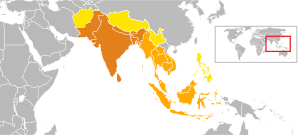
Historic Indosphere cultural influence zone of Greater Republic of india for transmission of elements of Indian culture including martial arts.
With expansion of Indosphere cultural influence of Greater Republic of india,[78] through transmission of Hinduism in Southeast Asia[79] [eighty] [81] and the Silk Road manual of Buddhism[82] [83] leading to Indianization of Southeast Asia through formation of non-Indian southeast Asian native Indianized kingdoms[84] which adopted sanskritized language[85] and other Indian elements[86] such every bit the honorific titles, Sanskritised naming of people, Sanskritised naming of places, Sankritised institutional mottos, Sanskritised educational institute names, too as adoption of Indian martial arts, Indian compages, Indian music and trip the light fantastic toe, traditional Indian wear, and Indian cuisine, a process which has also been aided by the ongoing celebrated expansion of Indian diaspora.[87] The martial arts influenced past the Indian martial arts include Angampora, Ankam, Bokator, Eskrima, Krabi krabong, Kbachkun Dambong-Veng, Khmer traditional wrestling, Pencak Silat, Silat, Thaing (Burmese), Võ thuật Bình Định, etc.
See also [edit]
- Angampora
- Banshay
- Bataireacht
- Bōjutsu
- Gatka
- Jūkendō
- Kalaripayattu
- Kendo
- Kenjutsu
- Krabi–krabong
- Kuttu Varisai
- Mardani khel
- Shastar Vidya
- Silambam
- Varma kalai
- Tahtib
- Thang-ta
References [edit]
- ^ attested in Classical Sanskrit only, specifically in the Anargharāghava.
- ^ attested from Epic Sanskrit; encounter Luijendijk, D.H. (2008). Kalarippayat: The Essence and Structure of an Indian Martial Art. Oprat (LuLu.com). ISBN978-1-58160-480-1. [ cocky-published source ]
- ^ a b c d "Actualizing Power and Crafting a Self in Kalarippayattu". Spa.ex.air-conditioning.uk. Retrieved 27 September 2015.
- ^ James G. Lochtefeld (2002). The Illustrated Encyclopedia of Hinduism: A-M . The Rosen Publishing Group. pp. 23–4. ISBN978-0-8239-3179-8.
- ^ Agrawal, Ashvini (1989). Rise and Fall of the Imperial Guptas. Motilal Banarsidass. ISBN9788120805927.
- ^ Kenoyer, Jonathan M. (1998). Ancient Cities of the Indus Valley Civilisation. Oxford University Press. ISBN9780195779400.
- ^ a b Phillip B. Zarrilli; Peter Hulton. Psychophysical Acting: An Intercultural Approach After Stanislavski. Routledge. p. 66.
- ^ a b Denise Cush; Catherine A. Robinson; Michael York. Encyclopedia of Hinduism. Psychology printing. p. 182.
- ^ a b George, Robinn (2010). "India's insistent intensity". Asian Geographic.
- ^ Department XIII: Samayapalana Parva, Book iv: Virata Parva, Mahabharata.
- ^ a b c d e f g h i Kim Taylor. "Kronos: A Chronological History of the Martial Arts and Combative Sports". Ejmas.com. Retrieved 27 September 2015.
- ^ Jeanine Auboyer (1965). Daily Life in Aboriginal India. French republic: Phoenix Press. pp. 58. ISBN1-84212-591-5.
- ^ a b Destruction of Maharashtra and the Marathas in the commencement half of seventh-century "Travels of Hsuen Tsang," Vol. 4, Samual Beal, P, 449.
- ^ a b The Timechart History of India. Robert Frederick Ltd. 2005. ISBN0-7554-5162-vii.
- ^ a b c d e Zarrilli, Phillip B. (1998). When the Trunk Becomes All Optics: Paradigms, Discourses and Practices of Power in Kalarippayattu, a South Indian Martial Art. Oxford: Oxford University Press.
- ^ Luijendijk 2008
- ^ [1] Archived 29 Baronial 2009 at the Wayback Automobile
- ^ Subramanian, N. (1966). Sangam polity. Mumbai: Asian Publishing House.
- ^ Raj, J. David Manuel (1977). The Origin and the Historical Development of Silambam Fencing: An Ancient Self-Defence force Sport of Republic of india. Oregon: College of Health, Physical Education and Recreation, Univ. of Oregon. pp. 44, 50, & 83.
- ^ Sports Authorisation of India (1987). Indigenous Games and Martial Arts of Republic of india. New Delhi: Sports Dominance of Bharat. pp. 91 & 94.
- ^ a b John Keay (2000). India: A History. New Delhi: HarperCollins. ISBN0-00-255717-seven.
- ^ a b c Bruce A. Haines (1995). Karate's History and Traditions (p. 23-25). Tuttle Publishing. ISBN 0-8048-1947-5.
- ^ Yard. D. Singhal, L. 5. Guru (1973). Anatomical and Obstetrical Considerations in Ancient Indian Surgery Based on Sarira-Sthana of Susruta Samhita.
- ^ a b c Zarrilli, Phillip B. (1992). "To Heal and/or To Harm: The Vital Spots (Marmmam/Varmam) in Two Southward Indian Martial Traditions Part I: Focus on Kerala's Kalarippayattu". Journal of Asian Martial Arts. 1 (i).
- ^ Radhey Shyam Chaurasia (2002). History of Ancient Bharat: Primeval Times to 1000 A. D. Atlantic Publishers & Distributors. p. 207. ISBN81-269-0027-X.
- ^ Alter, Joseph S. (Baronial 1992b). The Wrestler's Trunk: Identity and Ideology in North India. Berkeley: University of California Press.
- ^ Historians such as P. B. Desai (History of Vijayanagar Empire, 1936), Henry Heras (The Aravidu Dynasty of Vijayanagara, 1927), B.A. Saletore (Social and Political Life in the Vijayanagara Empire, 1930), One thousand.Due south. Gai (Archaeological Survey of Republic of india), William Coelho (The Hoysala Vamsa, 1955) and Kamath (Kamath 2001, pp157–160)
- ^ Suryanath U. Kamath (2001) [1980]. A concise history of Karnataka: from pre-historic times to the present. Bangalore: Jupiter Books.
- ^ Nilakanta Sastri, K.A. (2002) [1955]. A history of Due south India from prehistoric times to the fall of Vijayanagar. New Delhi: Indian Branch, Oxford University Press. ISBN0-19-560686-8.
- ^ Henry Heras (1927). The Aravidu Dynasty of Vijayanagara. Madras.
- ^ Edward Greyness (1892). Pietro Della Valle – The Travels.
- ^ Robert Sewell (1924). A Forgotten Empire (Vijayanagar): A Contribution to the History of India.
- ^ For instance, the Akbarnama tells that Emperor Akbar practiced gatka every twenty-four hours
- ^ Wiethase, H. "Dhanurveda: The knowledge of the bow". bogenloewe . Retrieved 24 June 2014.
- ^ The Ain I Akbari of Abul Fazl 'Allami. Gorgias Press. 1993.
- ^ a b Tobias Capwell (2009). The World Encyclopedia Of Knives, Daggers And Bayonets. Anness Publishing.
- ^ "A history of Dasnami Naga Sanyasis, Sir Jadunath Sarkar, Sri Panchayati Akhara Mahanirvani, Allahabad" (PDF). Dspace.wbpublibnet.gov.in. Retrieved 27 September 2015.
- ^ a b Alter, Joseph S. (May 1992a). "The "sannyasi" and the Indian Wrestler: The Anatomy of a Relationship". American Ethnologist. 19 (two): 317–336. doi:10.1525/ae.1992.19.two.02a00070. ISSN 0094-0496.
- ^ a b Alter, Joseph Southward. (1992b). The Wrestler's Body: Identity and Ideology in North India. Berkeley: University of California Printing. ISBN0-520-07697-4.
- ^ One thousand. L. Khurana (1993). Medieval Bharat. Agra: Lakshmi Narain Agarwal. ISBN81-85778-xv-ix.
- ^ A History of Warfare: Field-Marshal Viscount Montgomery of Alamein, William Morrow & Co; 1st edition (January 1983), ISBN 978-0688016456
- ^ Edwards, Frank (2004). The Gaysh. ISBN9781874622963 . Retrieved 10 March 2015.
- ^ "Odisha Regime Portal" (PDF). Orissa.gov.in. Retrieved 27 September 2015.
- ^ "Reminiscences of Paika Vidroha". Orissatoday.com. Retrieved 28 July 2010.
- ^ "Welcome to". Iakoweb.com. Archived from the original on 12 July 2011. Retrieved 28 July 2010.
- ^ "Paika Mutiny was the showtime liberty struggle: Orissa Governor, Odisha Current News, Odisha Latest Headlines". Archived from the original on 19 July 2013. Retrieved x March 2015.
- ^ Luijendijk, D.H. (2005). Kalarippayat: India's Ancient Martial Art. Boulder: Paladin Press. ISBN1-58160-480-7.
- ^ Runjeet Singh; Chief of Lahore (June 1838). "The Saturday Magazine" (248).
- ^ "Martial Arts in India". Retrieved ten March 2015.
- ^ "Welcome to IAKOWEB.COM". Archived from the original on 24 September 2015. Retrieved 10 March 2015.
- ^ (1.) bhrāntam (2.) udbhrāntam (iii.) āviddham (4.) āplutaṃ (5.) viplutaṃ (6.) sṛtaṃ (7.) sampātaṃ (8.) samudīśañca (9.-x.) śyenapātamathākulaṃ (251.1) (11.) uddhūtam (12.) avadhūtañca (xiii.) savyaṃ (fourteen.) dakṣiṇam eva ca (15.-16.) anālakṣita-visphoṭau (17.-18.) karālendramahāsakhau (251.two) (xix.-20.) vikarāla-nipātau ca (21.-22.) vibhīṣaṇa-bhayānakau (23–24.) samagrārdha (25.) tṛtīyāṃśapāda (26.-28.) pādardhavārijāḥ (251.three) (29.) pratyālīḍham (xxx.) athālīḍhaṃ (31.) varāhaṃ (32.) lulitan tathā (251.4ab)
- ^ Parmeshwaranand, Swami (2001). Encyclopaedic Dictionary of Puranas – Swami Parmeshwaranand. p. 467. ISBN9788176252263 . Retrieved 27 September 2015.
- ^ "Vasisthas Dhanurveda Samhita : (Text with English Translation)". Goa Academy Library . Retrieved viii May 2014.
- ^ Manmatha Nath Dutt (1869). Kamandakiya Nitisara or, The Elements of polity, in English. Internet Annal. Calcutta, Manmatha Nath Dutt. Retrieved 24 June 2014.
- ^ P.C. Chakravarti (2004). The Art of War in Ancient India. Low Toll Publications. ISBN978-8185557472.
- ^ Agni Purana. Sri Satguru Publications. 2009.
- ^ a b c d e f Donn F. Draeger and Robert W. Smith (1969). Comprehensive Asian Fighting Arts. Kondansha International Limited.
- ^ "Traditional armed forces practices in North India". 15 Jan 2014.
- ^ Desai, Sudha Vishwanath (1980). Social life in Maharashtra under the Peshwas. Popular Prakashan. p. 131. OCLC 8243834.
- ^ "History of Archery in India".
- ^ The Rig Veda/Mandala 6/Hymn 75/v
- ^ Gabriel, Richard A. (2002). The Swell Armies of Antiquity. Greenwood Publishing Group. ISBN978-0-275-97809-ix.
- ^ no primary attribution, quoted in Dirk H. A. Kolff. Naukar, Rajput, & Sepoy. The ethnohistory of the armed services labour marketplace in Hindustan, 1450–1860. Academy of Cambridge Oriental Publications no. 43. Cambridge University Printing 1990.
- ^ Richard F. Burton (1884). The Volume Of The Sword. Chatto and Windus. ISBN0-486-25434-8.
- ^ "The civilization and crisis of kushti". The Hindu. 31 Oct 2013. Retrieved ii July 2016.
- ^ "Nagaland Kickboxing". Last Man Standing. BBC and Discovery The states. 17 July 2007
- ^ "Bal Vidya and Yashwanti Mall Vidya".
- ^ "Bala Vidya (For Men and Women) – SHREE ANIRUDDHA UPASANA FOUNDATION". Archived from the original on 29 July 2017.
- ^ Kalā
- ^ "Sixty iv arts of ancient bharat". 17 March 2015.
- ^ a b c d Christopher Fernandes (2011). Vajramushti: Martial Arts of India. Creative House International Press.
- ^ a b c Bipasha Raha; Subhayu Chattopadhyay (22 December 2017). Mapping the Path to Maturity: A Continued History of Bengal and the North-East. Taylor & Francis. pp. 102–. ISBN978-1-351-03412-8.
- ^ a b c Southward. Foster (10 June 2009). Worlding Dance. Palgrave Macmillan UK. pp. 129–. ISBN978-0-230-23684-4.
- ^ "International Council of Sqay". Archived from the original on 5 August 2018. Retrieved 5 November 2013.
- ^ "Paika Akheda the Martial Fine art of Odisha". International Journal of Concrete Instruction, Sports and Health . Retrieved 12 December 2020.
- ^ "Martial Traditions of Odisha". Odisha Review: 47–49. Retrieved 12 December 2020.
- ^ Marco Ferrarese (July 2014). "Keeping Silambam spinning". Penang Monthly: xx–22.
- ^ Kenneth R. Hal (1985). Maritime Trade and State Development in Early on Southeast Asia. University of Hawaii Press. p. 63. ISBN978-0-8248-0843-three.
- ^ Guy, John (2014). Lost Kingdoms: Hindu-Buddhist Sculpture of Early Southeast Asia, Metropolitan museum, New York: exhibition catalogues. Metropolitan Museum of Art. ISBN9781588395245.
- ^ "The spread of Hinduism in Southeast Asia and the Pacific". Britannica.
- ^ Kapur; Kamlesh (2010). History Of Ancient Republic of india (portraits Of A Nation), 1/e. Sterling Publishers Pvt. Ltd. p. 465. ISBN978-81-207-4910-8.
- ^ Fussman, Gérard (2008–2009). "History of Republic of india and Greater India". La Lettre du Collège de France (4): 24–25. doi:10.4000/lettre-cdf.756 . Retrieved 20 Dec 2016.
- ^ Coedès, George (1968). Walter F. Vella (ed.). The Indianized States of Southeast Asia. trans.Susan Brown Cowing. University of Hawaii Printing. ISBN978-0-8248-0368-1.
- ^ Manguin, Pierre-Yves (2002), "From Funan to Sriwijaya: Cultural continuities and discontinuities in the Early Historical maritime states of Southeast Asia", 25 tahun kerjasama Pusat Penelitian Arkeologi dan Ecole française d'Extrême-Orient, Jakarta: Pusat Penelitian Arkeologi / EFEO, pp. 59–82
- ^ Lavy, Paul (2003), "As in Heaven, So on Earth: The Politics of Visnu Siva and Harihara Images in Preangkorian Khmer Culture", Journal of Southeast Asian Studies, 34 (1): 21–39, doi:10.1017/S002246340300002X, S2CID 154819912, retrieved 23 December 2015
- ^ Kulke, Hermann (2004). A history of India. Rothermund, Dietmar 1933- (fourth ed.). New York: Routledge. ISBN0203391268. OCLC 57054139.
- ^ Kulke, Hermann (2004). A history of Bharat. Rothermund, Dietmar, 1933– (4th ed.). New York: Routledge. ISBN0203391268. OCLC 57054139.
- ^ "Nagas: Once were warriors". The Times of India. Archived from the original on 3 December 2013. Retrieved ten March 2015.
- ^ "National Museum, New Delhi". Retrieved 10 March 2015.
- ^ "National Museum, New Delhi". Retrieved x March 2015.
- ^ B.V.South. Bhaskar (xv Oct 2010). "Aboriginal martial art form yet in faddy". The Hindu . Retrieved 10 March 2015.
DOWNLOAD HERE
Posted by: millercluat1946.blogspot.com


0 Comments